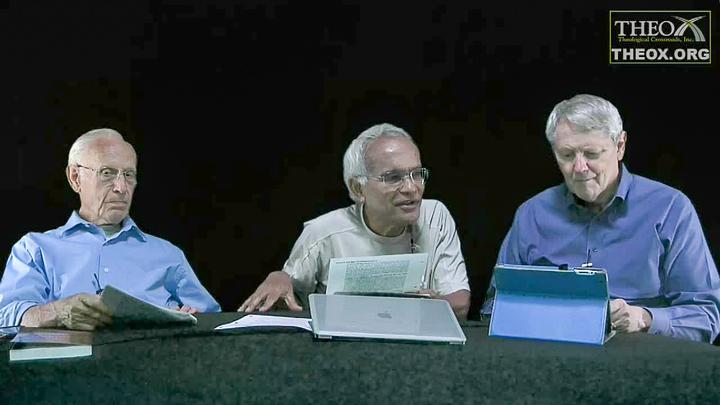
The Gift of Prophecy
New Testament Prophets
Lesson #4 for October 24, 2026
Scriptures: Matthew 16:13-16; Ephesians 2:20; 6:10-18; Revelation 22:6; Luke 2:36-38; Acts 21:9; 1 Corinthians 12:4-6.
{{Note that text which is displayed in red letters and/or is within double curly brackets, i.e. between “{{” and “}},” is considered important material to make available to you the user of this lesson but is not included in the recorded audio version of this lesson.}}
- What can we learn about God from studying the prophets of the New Testament?
[From the Adult Sabbath School Bible Study Guide=BSG:] {{As a father was driving, his son scanned the cars passing by in order to spot those that were the same as his dad’s. The father then pointed to a car and exclaimed, “Son, that was the same as my first car!” When they got home, the father pulled out the owner’s manual to his first car, along with the manual to the current car. He carefully showed his son the features of each vehicle, highlighting things that were alike and what had been changed. However, when the father compared the two engines, everything was identical. Much had changed, but not the engine.}}
God spoke through prophets in the Old and New Testaments, and the continuity and harmony in their messages is because the Holy Spirit—the Source, {{or “Engine,”}} of divine inspiration—has remained the same. The Holy Spirit always empowers true prophets through the gift of prophecy. He also places Christ at the center of the prophets’ messages, as Hebrews makes clear (Heb. 1:1–3).—BSG* for Sabbath Afternoon, October 17.†‡§
Hebrews 1:1-3: 1In the past God spoke to our ancestors many times and in many ways through the prophets, 2but in these last days he has spoken to us through his Son. He is the one through whom God created the universe, the one whom God has chosen to possess all things at the end. {{3He reflects the brightness of God’s glory and is the exact likeness of God’s own being, sustaining the universe with his powerful word. After achieving forgiveness for the sins of all human beings, he sat down in heaven at the right side of God, the Supreme Power.}}—American Bible Society. (©1992). The Holy Bible: The Good News Translation®* [GNT] (Today’s English Version) [TEV], Second Edition (Hebrews 1:1-3). Philadelphia: American Bible Society [abbreviated as Good News Bible-TEV* or GNB-TEV*].†‡
- If God the Father had come to this earth instead of Jesus, history would not have changed. God is just like Jesus was!
[From the writings of Ellen G. White=EGW:] Had God the Father come to our world and dwelt among us, {{veiling His glory, humbling Himself, that humanity might look upon Him,}} the history that we have of the life of Christ would not have been changed in unfolding its record of His own condescending grace. In every act of Jesus, in every lesson of His instruction, we are to see and hear and recognize God. In sight, in hearing, in effect, it is the voice and movements of the Father. But language seems to be so feeble! {{I refrain, and with John exclaim, “Behold what manner of love hath the Father bestowed upon us, that we should be called the sons of God; therefore the world knoweth us not because it knew him not.” [1 John 3:1.]}}—Ellen G. White, Letters and Manuscripts,* vol. 10 [1895], 1.2160, Letter 83, 1895,* par. 25.†‡Ω [Compare That I May Know Him 338.4.]‡ [https://egwwritings.org/read?panels=p14060.5690031&index=0]‡
[https://egwwritings.org/read?panels=p126.2231&index=0 =TMK]‡
[BSG:] [In this lesson,] we will examine the gift of prophecy in the New Testament, looking at who functioned as prophets, what prophets did, how prophets compared to apostles, and the danger of false prophets, as well.—BSG* for Sabbath Afternoon, October 17.‡
[From the Adult Teachers Sabbath School Bible Study Guide=T-BSG:] The theme of this … lesson naturally follows that of … [the prior lesson] but addresses the nature of New Testament prophets, who functioned as Spirit-empowered messengers and who provided guidance, encouragement, and exhortation to the early church. The role of these prophets was to proclaim God’s message, sometimes revealing future events, but primarily strengthening believers and calling them to faithfulness. Unlike Old Testament prophets, whose authority was foundational to Israel’s covenant relationship with God, New Testament prophets operated within the church community, complementing apostolic teaching and pointing to Christ as the ultimate revelation of God’s will. As the New Testament prophets uplifted Christ as the Messiah, so did Ellen G. White.—T-BSG* 52.†‡
Jesus Is the Greatest Prophet!
[T-BSG:] Jesus Christ is the ultimate prophet, surpassing all who came before Him [as well as all who came after Him]. Unlike Old Testament prophets who spoke God’s word, Jesus was the Word made flesh (John 1:14). He didn’t just proclaim divine truth; He embodied it. Jesus acknowledged His prophetic role, stating, “ ‘A prophet is not without honor except in his hometown’ ” (Matt. 13:57, ESV), highlighting His rejection, despite His authority.—T-BSG* 52.†‡§
[BSG:] Moses predicted that “ ‘the Lord your God will raise up for you a Prophet like me from your midst, from your brethren. Him you shall hear’ ” (Deut. 18:15, NKJV). Who was the prophet? Scripture itself makes it clear: it was pointing to Jesus Himself. {{“ ‘For Moses truly said to the fathers, “The Lord [sic] your God will raise up for you a Prophet like me from your brethren. Him you shall hear in all things, whatever He says to you” ’ ”}} (Acts 3:22, NKJV; see also John 6:14).
What is the prophetic role of Jesus? How was this question answered in Jesus’ time? (Matt. 16:13–16, Mark 8:27–29, Luke 9:18–20).—BSG* for Sunday, October 18.‡§
[BSG:] Jesus, as the Christ, the Messiah, is the One to whom all the Old Testament prophets pointed. In the New Testament, Jesus is recognized as the fulfillment of their Messianic prophecies. In Luke 24:13–35 [on the road to Emmaus], He presents Himself as the One to whom the Messianic prophecies pointed.—BSG* for Sunday, October 18.†‡
- Jesus repeatedly told His disciples that His life was the fulfillment of Old Testament prophecies and expressions. This is pointed out clearly in places like Luke 24:13-35 (on the road to Emmaus) and John 5:39. Paul also spelled it out in 1 Corinthians 10:1-4.
{{John 5:39: “You study the Scriptures, because you think that in them you will find eternal life. And these very Scriptures speak about me!”—Good News Bible-TEV.*†
1 Corinthians 10:1-4: 1I want you to remember, my friends, what happened to our ancestors who followed Moses. They were all under the protection of the cloud, and all passed safely through the Red Sea. 2In the cloud and in the sea they were all baptized as followers of Moses. 3All ate the same spiritual bread 4and drank the same spiritual drink. They drank from the spiritual rock that went with them; and that rock was Christ himself.—Good News Bible-TEV.*†}}
[BSG:] In fact, in John 1:1–5, the description given of the Word here does not fit any human being or mere human prophet. The Word is identified as the Creator, for “all things were made through Him, and without Him nothing was made that was made” (John 1:3, NKJV). That is, He created all that was created, which is the entire cosmos, now estimated to be 93 billion light-years wide.—BSG* for Sunday, October 18.‡§
{{John 1:1-5: 1In the beginning the Word already existed; the Word was with God, and the Word was God. 2From the very beginning the Word was with God. 3Through him God made all things; not one thing in all creation was made without him. 4The Word was the source of life, and this life brought light to people. 5The light shines in the darkness, and the darkness has never put it out.—Good News Bible-TEV.*†}}
[BSG:] In every “and God said” of Genesis 1, we hear Jesus speaking. He who said, “Let there be light” (Gen. 1:3) is also the “light of men” (John 1:4), and through the plan of salvation (John 1:4, 5), He was dispelling earth’s darkness.—BSG* for Sunday, October 18.†‡§
Genesis 1:3: Then God commanded [KJV*: And God said], “Let there be light”—and light appeared.—Good News Bible-TEV.*‡
[BSG:] God’s prophetic words are certain and confirmed. When heeded, they are “a light that shines in a dark place, until the day dawns and the morning star rises in your hearts” (2 Pet. 1:19, NKJV). Prophecy will continue to bring light to our sinful world until Jesus, “the Morning Star,” and Source of that prophetic light, will usher in His eternal kingdom.
Until then, through His life, death, and resurrection, Christ offers us all eternal life. The only question is whether or not we will accept it.—BSG* for Sunday, October 18.‡§
- The life and death of Jesus give us a choice: (1) With the help of the angels and the Holy Spirit, we can either choose to follow the pattern of His life as far as possible, and thus, live forever; or, (2) We will die the death that Jesus died, separated from His Father, the only Source of life and be eternally dead.
{{[BSG:] Dwell on the fact that Jesus, the Creator (John 1:1–3), is also the One who died on the cross for your sins. What does this amazing truth teach about the reality of God’s love for us?—BSG* for Sunday.‡§}}
Apostles and New Testament Prophets
[T-BSG:] John the Baptist also held a unique prophetic role. Recognized as a prophet (Matt. 11:9), he acted and spoke as the Old Testament prophets did, calling people to repentance and preparing the way for the Messiah (Isa. 40:3, Matt. 3:3). However, John was distinct. He was the bridge between the old and new covenants, the old era’s last prophet and the new era’s forerunner. He stood “at the fulcrum of the ages” and “on the brink of the age of fulfillment.”—Christopher Rowland, “Prophets, Prophecy,” in Dictionary of Jesus and the Gospels, ed. Joel B. Green et al., 2nd ed. (Downers Grove, IL; Nottingham, England: IVP Academic; IVP, 2013), p. 707.—T-BSG* 52.†‡§
[T-BSG:] New Testament apostles and prophets had the same authority as the Old Testament prophets.
The New Testament confirms the continuation of the prophetic gift, equating the authority of New Testament apostles and prophets with that of their Old Testament counterparts. In Ephesians 3:5, Paul writes that the mystery of Christ has “now been revealed to his holy apostles and prophets by the Spirit” (ESV). Similarly, Ephesians 2:20 describes the church as being “built on the foundation of the apostles and prophets, Christ Jesus himself being the cornerstone” (ESV). As Daniel B. Wallace explains, these references point to the same group of prophets who, alongside the apostles, formed the church’s foundation (Daniel B. Wallace, Greek Grammar Beyond the Basics: An Exegetical Syntax of the New Testament [Grand Rapids, MI: Zondervan, 1996], p. 286).—T-BSG* 53.‡Ω§
[BSG:] The New Testament mentions the work of prophets and apostles. The apostles were “messengers,” or “ones sent forth” from God, as defined by the Greek word apostolos. Throughout the Gospels, the word “apostle” refers to the 12 disciples. The rest of the New Testament supports this idea and includes other individuals who were not among Christ’s original disciples.
Paul calls himself an apostle 12 times in his epistles. In Romans 1:1, 2, he connects his apostolic calling, and the content of his preaching, with the message of the Old Testament prophets. Paul presents himself as an apostle to the Gentiles (Rom. 11:13). He was appointed “through the will of God” (1 Cor. 1:1).—BSG* Monday, October 19.†‡§
[BSG:] Unlike the priests who followed a familial line from fathers to sons, God appointed prophets and apostles according to His will. When Paul’s apostleship was in dispute, he defended his calling (1 Cor. 9:1, 2). Paul saw his apostleship as building upon the work of Christ, the Foundation of the church (Eph. 2:20). As recipients of God’s revelation, the apostles therefore possess the same level of inspiration as the prophets (Eph. 3:1–5).—BSG* Monday, October 19.†‡§
[BSG:] In 2 Peter 3:1, 2, Peter makes reference to prophets as those who came before and whose words were important, but now the apostles are presented as carrying the same authority. In these verses, reference is made to Old and New Testament times. While prophets may seem to be God’s messengers of the Old Testament era and apostles God’s messengers of the New Testament era, there were also people who prophesied or exercised the prophetic gift but who were not apostles. The gift of prophecy was not limited to the apostles in New Testament times. And not all prophets were apostles (Acts 15:32).—BSG* for Monday, October 19.†‡§
- Read 2 Peter 3:1-2 and Acts 15:32.
{{2 Peter 3:1-2: 1My dear friends, this is now the second letter I have written you. In both letters I have tried to arouse pure thoughts in your minds by reminding you of these things. 2I want you to remember the words that were spoken long ago by the holy prophets, and the command from the Lord and Savior which was given you by your apostles.—Good News Bible-TEV.*
Acts 15:32: Judas and Silas, who were themselves prophets, spoke a long time with them, giving them courage and strength.—Good News Bible-TEV.*†}}
- What was and is to be the result of the work of apostles and prophets?
Ephesians 2:20: You, too, are built upon the foundation laid by the apostles and prophets, the cornerstone being Christ Jesus himself.—Good News Bible-TEV.*†
- Read Ephesians 3:1-5.
{{Ephesians 3:1-5: 1For this reason I, Paul, the prisoner of Christ Jesus for the sake of you Gentiles, pray to God. 2Surely you have heard that God in his grace has given me this work to do for your good. 3God revealed his secret plan and made it known to me. (I have written briefly about this, 4and if you will read what I have written, you can learn about my understanding of the secret of Christ.) 5In past times human beings were not told this secret, but God has revealed it now by the Spirit to his holy apostles and prophets.—Good News Bible-TEV.*†}}
[BSG:] And as we also know from reading what the apostles in the New Testament wrote, Jesus was the center of almost all that they wrote. In one way or another, His life, death, resurrection, high-priestly ministry, and return were their central focus.—BSG* for Monday, October 19.†‡
- What do we know about Jesus’s high-priestly ministry in the heavenly sanctuary?
Zechariah 3:1-5: 1In another vision the Lord showed me the High Priest Joshua standing before the angel of the Lord. And there beside Joshua stood Satan, ready to bring an accusation against him. 2The angel of the Lord said to Satan, “May the Lord condemn you, Satan! May the Lord, who loves Jerusalem, condemn you. [Notice that it is Satan who is condemned in the judgment!] This man is like a stick snatched from the fire.”
3Joshua was standing there, wearing filthy clothes. 4The angel said to his heavenly attendants, “Take away the filthy clothes this man is wearing.” Then he said to Joshua, “I have taken away your sin and will give you new clothes to wear.”
5He commanded the attendants to put a clean turban on Joshua’s head. They did so, and then they put the new clothes on him while the angel of the Lord stood there.—Good News Bible-TEV.*†‡
The Apostles and New Testament Prophets and Their Functions
- How did New Testament prophets function in relation to Christ and the church?
[BSG:] The Bible is the only official record we have of the words of the apostles and prophets about Jesus, His life, and works. What should this tell us about why the Bible must have final authority for what we believe about Jesus and His death for us?—BSG* for Monday.‡
[T-BSG:] In the New Testament, the gift of prophecy functioned as exhortation and encouragement, pointing to Christ.
The coming of Christ transformed the nature of prophecy. While Old Testament prophets looked forward to the Messiah, New Testament prophets centered their message on Jesus’ life, death, resurrection, and return. Revelation 19:10 declares that “the testimony of Jesus is the spirit of prophecy,” making Christ the focus of all prophetic activity.—T-BSG* 53.†‡
{{[T-BSG:] Ekkehardt Mueller emphasizes that “the New Testament prophet focused even more on Jesus, His life, His words, and His acts than the Old Testament prophet had focused on the Messiah.”—“The Prophetic Voice in the New Testament: An Overview,” in Alberto R. Timm and Dwain Esmond, eds., The Gift of Prophecy in Scripture and History (Silver Spring, MD: Review and Herald Publishing Association, 2015), pp. 55, 56. Their task was to make Christ’s message relevant, urging the church to remain faithful and hopeful in anticipation of His return.—T-BSG* 53.‡§}}
- The New Testament makes it clear that those who are described as prophets gave encouragement and comfort to church members under certain situations. They would also help in building up the body of Christ, with Christ Himself as the chief Cornerstone. And, ultimately, these prophets would also describe certain future events to guide the church.
1 Corinthians 14:3: But those who proclaim God’s message speak to people and give them help, encouragement, and comfort.—GNB-TEV.*†
- Read Ephesians 4:11-13.
{{Ephesians 4:11-13: 11It was he who “gave gifts to people”; he appointed some to be apostles, others to be prophets, others to be evangelists, others to be pastors and teachers. 12He did this to prepare all God’s people for the work of Christian service, in order to build up the body of Christ. 13And so we shall all come together to that oneness in our faith and in our knowledge of the Son of God; we shall become mature people, reaching to the very height of Christ’s full stature.—GNB-TEV.*†}}
Revelation 22:6: Then the angel said to me, “These words are true and can be trusted. And the Lord God, who gives his Spirit to the prophets, has sent his angel to show his servants what must happen very soon.”—Good News Bible-TEV.*†
[BSG:] In 1 Corinthians 12:10, prophecy is mentioned among other spiritual gifts. In the body of Christ metaphor (1 Cor. 12:27, 28), prophets are mentioned after apostles, who also received revelations from God. According to 1 Corinthians 14:3: “He who prophesies speaks edification and exhortation and comfort to men” (NKJV).—BSG* for Tuesday, October 20.‡§
1 Corinthians 12:10 [NKJV]: To another the working of miracles, to another prophecy, to another discerning of spirits, to another different kinds of tongues, to another the interpretation of tongues.—New King James Version.*†§
1 Corinthians 12:27-28: 27All of you are Christ’s body, and each one is a part of it. 28In the church God has put all in place: in the first place apostles, in the second place prophets, {{and in the third place teachers; then those who perform miracles, followed by those who are given the power to heal or to help others or to direct them or to speak in strange tongues.}}—GNB-TEV.*
[BSG:] Ephesians 4:11–13 lists a similar cluster of spiritual gifts, as does 1 Corinthians 12. Prophets are mentioned among apostles, evangelists, pastors, and teachers (Eph. 4:11). These persons exist for “the equipping of the saints for the work of ministry, for the edifying of the body of Christ, till we all come to the unity of the faith and the knowledge of the Son of God, to a perfect man, to the measure of the stature of the fullness of Christ” (Eph. 4:12, 13, NKJV). As seen here and elsewhere, Jesus is the central focus of their message.
The book of Acts talked about two prophets, Judas and Silas (neither one having written a book in the Bible [However, see 1 Thessalonians 1:1; 2 Thessalonians 1:1; and 1 Peter 5:12.]), who “exhorted and strengthened the brethren with many words” (Acts 15:32, NKJV). Though, yes, at times prophets do have to utter warnings, even stern warnings at times, they also—depending upon the circumstance—do offer words of encouragement, especially in trying times, words that were no doubt greatly appreciated by those who needed to hear them and the hope and promise that they contained.
{{The work of encouragement also is mentioned in the context of prophesying (1 Cor. 14:31, NKJV). In times of tribulation and persecution, the gift of prophecy has been a source of encouragement and hope.}}—BSG* for Tuesday, October 20.‡§
1 Corinthians 14:31: All of you may proclaim God’s message, one by one, so that everyone will learn and be encouraged.—Good News Bible-TEV.*
[BSG:] In Revelation 22:6, Jesus is presented as “Lord God of the holy prophets” and whose “ ‘words are faithful and true’ ” (NKJV). Of course, anything that comes from God’s servants, when they are speaking for God, is going to be “faithful and true,” too. In a world in which we can trust so little, we can indeed trust what the prophets of the Lord say, especially in His Word, our final and ultimate authority.—BSG* for Tuesday.‡§
The New Testament Names Female Prophets and Young Pastoral Associates
[T-BSG:] The prophetic gift manifested itself in women as well as men.
The New Testament highlights that the prophetic gift was given to both men and women. In Acts 2:17, 18, Peter, quoting Joel 2:28, 29, declared: “ ‘Your sons and daughters will prophesy. . . . Even on my servants, both men and women, I will pour out my Spirit’ ” (NIV). This gender-inclusive outpouring was visibly fulfilled in the early church.—T-BSG* 53-54.‡§
[T-BSG:] Women, such as Anna (Luke 2:36–38) and Philip’s four daughters (Acts 21:9), were recognized prophets, playing vital roles in proclaiming God’s message. Their inclusion underscores the Holy Spirit’s impartial distribution of gifts, empowering both genders to serve in the prophetic role as messengers of God’s truth.—T-BSG* 54.†‡§
- What can we learn from these passages about female prophets in the New Testament?
- Read Luke 2:36-38.
{{Luke 2:36-38: 36–37There was a very old prophet, a widow named Anna, daughter of Phanuel of the tribe of Asher. She had been married for only seven years and was now 84 years old. She never left the Temple; day and night she worshiped God, fasting and praying. 38That very same hour she arrived and gave thanks to God and spoke about the child to all who were waiting for God to set Jerusalem free.—Good News Bible-TEV.*†}}
Acts 21:9: He [Philip] had four unmarried daughters who proclaimed God’s message.—Good News Bible-TEV.*†‡
[BSG:] In Old Testament times, God called both men and women to be His messengers. In New Testament times, there is clear evidence of female prophets. Anna was the first one called a “prophetess” in the New Testament. She is someone who, in her full-time ministry, “served God with fastings and prayers night and day. And . . . she gave thanks to the Lord, and spoke of Him” (Luke 2:37, 38, NKJV).
Acts 21:9 says that Philip had “four virgin daughters who prophesied” (NKJV). New Testament historians, such as Eusebius, have found later texts that mention where they possibly lived, and then were buried. Either way, what we do see are women, most likely young women, who have the prophetic gift. We don’t know exactly what they prophesied or the extent of their ministry. One thing, however, that we do know about these young women with the prophetic gift: none of their prophetic words made it into the canon, the Bible. That is, like many others, they were noncanonical prophets, true prophets whose words, writings, whatever, were not made into biblical books.
In addition to women prophets, young pastors worked in close association with apostles. Apostles mentored young leaders for ministry. Paul, for instance, addressed Timothy as “a true son in the faith” (1 Tim. 1:2, NKJV; see also 1 Tim. 4:12). Paul taught Timothy the basics of pastoral ministry. He states concerning his calling: “This charge I commit to you, son Timothy, according to the prophecies previously made concerning you, that by them you may wage the good warfare” (1 Tim. 1:18, NKJV).—BSG* for Wednesday, October 21.†‡§
- Read 1 Timothy 1:2 and 1 Timothy 4:12.
{{1 Timothy 1:2: To Timothy, my true son in the faith: May God the Father and Christ Jesus our Lord give you grace, mercy, and peace.—GNB-TEV.*
1 Timothy 4:12: Do not let anyone look down on you because you are young, but be an example for the believers in your speech, your conduct, your love, faith, and purity.—Good News Bible-TEV.*}}
- Paul not only mentored Timothy, but he also mentored Titus.
[BSG:] In Titus 1:4, Paul introduced Titus as “a true son in our common faith” (NKJV). Paul gave Titus the task of appointing leaders for the believers in Crete, a challenging congregation. He offered young Titus spiritual counsel on how to approach this important responsibility, then concluded: “Speak these things, exhort, and rebuke with all authority. Let no one despise you” (Titus 2:15, NKJV).—BSG* for Wednesday.‡§
- Read Titus 1:4 and Titus 2:15.
{{Titus 1:4: I write to Titus, my true son in the faith that we have in common.
May God the Father and Christ Jesus our Savior give you grace and peace.—Good News Bible-TEV.*
Titus 2:15: Teach these things and use your full authority as you encourage and rebuke your hearers. Let none of them look down on you.—GNB-TEV.*}}
[BSG:] Young, old, male, female—we all can have a role to play in God’s work. What is your role, and how can you do even more?—BSG* for Wednesday, October 21.‡
False Prophets, Even in the New Testament
[BSG:] Read Matthew 24:23, 24. What does Jesus warn us about here? Why should we take this warning so seriously?—BSG* for Thursday.‡
- Read Matthew 24:23-24.
{{Matthew 24:23-24: 23 “Then, if anyone says to you, ‘Look, here is the Messiah!’ or ‘There he is!’—do not believe it. 24For false Messiahs and false prophets will appear; they will perform great miracles and wonders in order to deceive even God’s chosen people, if possible.”—GNB-TEV.*† [How would Satan and his associates deceive the very elect, “if possible”?]‡}}
- Who is the most dangerous and most cunning of the false prophets? With certainty, it is Satan himself who deceived about one-third of the sinless angels when they were in the presence of God!
- See Revelation 13, especially Revelation 13:14-17 and Revelation 13:5-8. See also Genesis 3:1-5, recounting the experience in the Garden of Eden when the serpent (Lucifer/Satan) called God a liar, saying in Genesis 3:4 (GNB-TEV*), “That’s not true” [referring to what God had said]!†‡
[BSG:] Jesus Himself couldn’t have been clearer: “ ‘For false christs and false prophets will rise and show great signs and wonders to deceive, if possible, even the elect’ ” (Matt. 24:24, NKJV).
The deceptions that He warns about must be quite persuasive, if, indeed, “great signs and wonders” will be part of it. Supernatural events, in and of themselves, are not evidence of God’s working, however persuasive they can appear. We have supernatural enemies. As Paul has warned us: “For we do not wrestle against flesh and blood, but against principalities, against powers, against the rulers of the darkness of this age, against spiritual hosts of wickedness in the heavenly places” (Eph 6:12, NKJV). And these powers work through false prophets.—BSG* for Thursday.†‡§
[T-BSG:] First John 4:1 urges Christians to “test the spirits to see whether they are from God, because many false prophets have gone out into the world” (NIV). True prophecy aligns with God’s Word, points to Christ, and edifies the church, while false prophets promote divisive doctrines and self-interest. Believers are called to discernment, ensuring that all prophetic messages are consistent with Scripture and are Christ-centered.—T-BSG* 54.†‡§
[BSG:] In fact, false prophets are nothing new. The New Testament refers to the false prophets in Old Testament times (Luke 6:26). In the New Testament, false prophets are likened to “ ‘ravenous wolves’ ” who are “ ‘in sheep’s clothing’ ” (Matt. 7:15, NKJV), and we are told that we will “ ‘know them by their fruits’ ” (Matt. 7:16, NKJV).—BSG* for Thursday.†‡§
- Read Luke 6:26 and Matthew 7:15-16.
{{Luke 6:26: “How terrible when all people speak well of you; their ancestors said the very same things about the false prophets.”—Good News Bible-TEV.*
Matthew 7:15-16: 15 “Be on your guard against false prophets; they come to you looking like sheep on the outside, but on the inside they are really like wild wolves. 16You will know them by what they do. Thorn bushes do not bear grapes, and briars do not bear figs.”—Good News Bible-TEV.*†}}
[BSG:] Their main work is deception (Matt. 7:17–20). Jesus Himself declared that “ ‘many false prophets will rise up and deceive many’ ” (Matt. 24:11, NKJV), and “ ‘if possible, even the elect’ ” (Matt. 24:24, NKJV; see also Mark 13:22, 1 John 4:1).—BSG* for Thursday, October 22.†‡§
- The great controversy began and has continued up until our day and beyond with Lucifer/Satan, speaking false things about Jesus/God. Satan has accused Jesus/God of being “arbitrary, exacting, vengeful, unforgiving, and severe.” (See Item #5 in https://www.theox.org/images/uploads/bbk/KHart_BTGG_PDF_Gnrl_Final_End_Sin_and_Sinners_18.pdf.)
- Read Matthew 7:17-20 and 24:11,24.
{{Matthew 7:17-20: 17 “A healthy tree bears good fruit, but a poor tree bears bad fruit. 18A healthy tree cannot bear bad fruit, and a poor tree cannot bear good fruit. 19And any tree that does not bear good fruit is cut down and thrown in the fire. 20So then, you will know the false prophets by what they do.”—Good News Bible-TEV.*†
Matthew 24:11,24: 11 “Then many false prophets will appear and fool many people….”
24 “For false Messiahs and false prophets will appear; they will perform great miracles and wonders in order to deceive even God’s chosen people, if possible.”—Good News Bible-TEV.*
Mark 13:22: “For false Messiahs and false prophets will appear. They will perform miracles and wonders in order to deceive even God’s chosen people, if possible.”—Good News Bible-TEV.*
1 John 4:1: My dear friends, do not believe all who claim to have the Spirit, but test them to find out if the spirit they have comes from God. For many false prophets have gone out everywhere.—Good News Bible-TEV.*}}
- What “tools” do we need in order to deal with false prophets?
- Read Ephesians 6:10-18.
{{Ephesians 6:10-18: 10Finally, build up your strength in union with the Lord and by means of his mighty power. 11Put on all the armor that God gives you, so that you will be able to stand up against the Devil’s evil tricks. 12For we are not fighting against human beings but against the wicked spiritual forces in the heavenly world, the rulers, authorities, and cosmic powers of this dark age. 13So put on God’s armor now! Then when the evil day comes, you will be able to resist the enemy’s attacks; and after fighting to the end, you will still hold your ground.
14So stand ready, with truth as a belt tight around your waist, with righteousness as your breastplate, 15and as your shoes the readiness to announce the Good News of peace. 16At all times carry faith as a shield; for with it you will be able to put out all the burning arrows shot by the Evil One. 17And accept salvation as a helmet, and the word of God as the sword which the Spirit gives you. 18Do all this in prayer, asking for God’s help. Pray on every occasion, as the Spirit leads. For this reason keep alert and never give up; pray always for all God’s people.—Good News Bible-TEV.*}}
[BSG:] Living by faith, putting on the “breastplate of righteousness,” being girded in the “truth,” along with surrendering to the Holy Spirit through prayer, and being grounded in His Word—these are the ways we can be protected from all that would otherwise lead us spiritually and theologically astray.
What can you do to arm yourself better against all the deceptions sweeping our world?—BSG* for Thursday, October 22.‡
Keeping Jesus and His Word (the Bible) As Our Center
[T-BSG:] Ellen G. White’s prophetic gift functioned similarly to the New Testament prophets in that she focused on Christ….
As early as 1851, she emphasized the importance of “dwelling upon the worthiness of Jesus, His love, His merits, and His great mercy.”—Ellen G. White, Early Writings, p. 73. Several years later, in 1857, she appealed to the youth: “If Christ be in us the hope of glory, we should discover such matchless charms in Him that the soul will be enamored.”—Testimonies for the Church, vol. 1, p. 162. [Portions are quoted in T-BSG.*]
In 1869, her early focus on Christ climaxed in “The Sufferings of Christ,” a small pamphlet published separately and then in Testimonies for the Church, volume 2, pages 200–215. [See 2T 200-215: https://egwwritings.org/read?panels=p120.831&index=0.] In the most moving and powerful language she could muster, Ellen G. White set forth Christ’s life, sufferings, and death as an atonement for our sins. Her burden was that “we should take broader and deeper views” of what Christ has done for us and “be enlivened, elevated, and enraptured with the theme of the love of the Father and the Son to man.”—Ellen G. White, Testimonies for the Church, vol. 2, p. 215. [Portions are quoted in T-BSG.*]
In the aftermath of the 1888 General Conference Session at Minneapolis, Ellen G. White was asked what she thought of the messages presented on salvation. She responded…. [Then, Ellen G. White is quoted; that is expanded below.]—T-BSG* 54-55.†‡§
[EGW:] I have had the question asked, “What do you think of this light that these men are presenting?” Why, I have been presenting it to you for the last 45 years—the matchless charms of Christ. This is what I have been trying to present before your minds. When Brother Waggoner brought out these ideas in Minneapolis, it was the first clear teaching on this subject from any human lips I had heard, excepting the conversations between myself and my husband. I have said to myself, It is because God has presented it to me in vision that I see it so clearly, and they cannot see it because they have never had it presented to them as I have. And when another presented it, every fiber of my heart said, Amen.—Ellen G. White, Sermons and Talks,* vol. 1, 116.4.†‡
[https://egwwritings.org/read?panels=p427.543&index=0]‡
[T-BSG:] These “matchless charms” were found in Christ’s redemptive works, divine nature, and person. Scores of statements on the merits of Christ and salvation in Him can be found throughout Ellen G. White’s writings during these forty years and thereafter to the end of her life (see, for example, Ellen G. White, Gospel Workers, pp. 156–162). [See the hyperlink below.]
{{For Further Study: See Peter M. van Bemmelen, “ ‘The Matchless Charms of Christ’ : Theological Significance of This Phrase in Ellen White’s Writings,” in Daniel Heinz et al., Christ, Salvation, and the Eschaton: Essays in Honor of Hans K. LaRondelle (Berrien Springs, MI: Old Testament Department, Seventh-day Adventist Theological Seminary, 2009), pp. 231–240.—T-BSG* 55.‡§ [The hyperlink to Gospel Workers* page 156.1 is:
https://egwwritings.org/read?panels=p35.784&index=0]‡}}
[BSG:] As we have learned, God called prophets at specific times and gave them important tasks. Their primary function was to bring people to a knowledge of God and a faithful relationship with Him. This was Ellen G. White’s guiding orientation. Her ministry had two primary functions: to lead people to Jesus and to point them to His Word—the Bible.
Ellen G. White had a lifelong passion for Jesus and a desire to share the love of God with others. Her famous five-book series, The Conflict of the Ages, begins and ends with the words “God is love.” In Steps to Christ, perhaps her most popular book, she wrote…. {{[Then, Ellen G. White is quoted; that is expanded below.]—BSG* for Friday, October 23.†‡§}}
[EGW:] Many have an idea that they must do some part of the work alone. They have trusted in Christ for the forgiveness of sin, but now they seek by their own efforts to live aright. But every such effort must fail. Jesus says, “Without Me ye can do nothing.” Our growth in grace, our joy, our usefulness,—all depend upon our union with Christ. It is by communion with Him, daily, hourly,—by abiding in Him,—that we are to grow in grace. He is not only the Author, but the Finisher of our faith. It is Christ first and last and always. He is to be with us, not only at the beginning and the end of our course, but at every step of the way. David says, “I have set the Lord always before me: because He is at my right hand, I shall not be moved.” Psalm 16:8.—Ellen G. White, Steps to Christ* 69.1.†‡
[https://egwwritings.org/read?panels=p108.269&index=0]‡
- Ellen White had physical struggles and other struggles as she wrote her many books and articles. In the 1890s as she was writing The Desire of Ages, she entered in her diary:
[EGW:] [E. G. White diary entry, July to November 1897 while in Australia:] I awaken at half past two, and offer up my prayer to God in the name of Jesus. I am weak in physical strength; my head is not free from pain; my left eye troubles me. In writing upon the life of Christ I am deeply wrought upon. I forget to breathe as I should. I cannot endure the intensity of feeling that comes over me as I think of what Christ has suffered in our world. {{He was a man of sorrows, and acquainted with grief; He was wounded for our transgressions; He was bruised for our iniquities; the chastisement of our peace was upon Him, and with His stripes we are healed, if we receive Him by faith as our personal Saviour [sic-British spelling]!}}—Ellen G. White, Manuscript 70, 1897,* par.1.‡ [Letters and Manuscripts,* vol. 12 (1897), 1.5512] [12LtMs, Ms 70, 1897, par. 1].‡
[https://egwwritings.org/read?panels=p14062.6071006&index=0]‡
- Ellen White encouraged Bible study. She is interpreted by many as referring to her own writings as the “lesser light” which should lead people to the “greater light,” the Bible.
[BSG:] Years later [years after 1851] she would write…. [Then, Ellen G. White is quoted; that is expanded below.]—BSG* for Friday.‡§
[EGW:] I am greatly burdened in mind because you are so tempted by the enemy that you do not know what is for your peace and rest in Jesus. {{I cannot sleep past one o’clock. I cannot endure the thought of Satan obtaining the victory by blindfolding you as he has been doing for years. You have had some victories, but many defeats.}} The Lord desires you to study your Bibles. He has not given any additional light to take the place of His Word. This light is to bring confused minds to His Word which, if eaten and digested, is as the life-blood of the soul. Then good works will be seen as light shining in darkness.—Ellen G. White, Letter 130, 1901,* par. 1. [Letters and Manuscripts,* vol. 16 (1901) p. 1.2155] [16LtMs, Lt 130, 1901, par. 1.]†‡
[https://egwwritings.org/read?panels=p14066.10209007&index=0]‡
[BSG:] The Bible was the second focus of Ellen White’s ministry. She saw her writings as a “lesser light” leading people to the “greater light”—the Bible (Selected Messages, book 3, p. 29). She always encouraged people to go to Scripture, where God has revealed His loving character and plan of salvation. As she put it early in her ministry: “I recommend to you, dear reader, the Word of God as the rule of your faith and practice.”—Selected Messages, book 3, p. 30. [See below for more.]—BSG* for Friday.‡§
[EGW:] Ellen White Calls Her Writings a Lesser Light—Little heed is given to the Bible, and the Lord has given a lesser light to lead men and women to the greater light.—The Review and Herald [sic], January 20, 1903 (Quoted in Colporteur Ministry [sic], 125.)—Ellen G. White, Selected Messages,* Book 3, 30.4.†‡
[https://egwwritings.org/read?panels=p100.130&index=0]‡
[EGW:] I recommend to you, dear reader, the word [sic] of God as the rule of your faith and practice. {{By that Word we are to be judged. God has, in that Word, promised to give visions in the “last days;” not for a new rule of faith, but for the comfort of his people, and to correct those who err from Bible truth. Thus God dealt with Peter when he was about to send him to preach to the Gentiles. Acts x.}}—Ellen G. White, A Sketch of the Christian Experience and Views of Ellen G. White* [ExV] 64.3 [1851].†‡
[https://egwwritings.org/read?panels=p3.396&index=0]‡
[EGW:] The Lord has sent His people much instruction, line upon line, precept upon precept, here a little and there a little. Little heed is given to the Bible, and the Lord has given a lesser light to lead men and women to the greater light. {{O, how much good might be accomplished if the books containing this light were read with a determination to carry out the principles they contain. There would be a thousandfold greater vigilance, a thousandfold more self-denial and resolute effort. And many more would now be rejoicing in the light of present truth.}}—Ellen G. White, Words of Encouragement to Workers in the Home Missionary Field, Pamphlet 164,* 6.1 [1904] [PH164 6.1]†‡
[https://egwwritings.org/read?panels=p346.20&index=0]‡
- Our ministries today must teach and follow the teachings of Jesus and Scripture.
[BSG:] Ellen G. White also believed that all who claim the prophetic mantle of Christ must teach “what Christ had taught. That which He had spoken, not only in person, but through all the prophets and teachers of the Old Testament, is here included. Human teaching is shut out.”—The Desire of Ages, p. 826. [See below for more of the quotation from The Desire of Ages.]
Ellen G. White kept Jesus and Scripture at the center of her Christian experience. To discover more, visit https://whiteestate.org/absg/4.—BSG* for Friday, October 23.‡
[EGW:] {{In the commission to His disciples, Christ not only outlined their work, but gave them their message. Teach the people, He said, “to observe all things whatsoever I have commanded you.”}} The disciples were to teach what Christ had taught. That which He had spoken, not only in person, but through all the prophets and teachers of the Old Testament, is here included. Human teaching is shut out. {{There is no place for tradition, for man’s theories and conclusions, or for church legislation. No laws ordained by ecclesiastical authority are included in the commission. None of these are Christ’s servants to teach. “The law and the prophets,” with the record of His own words and deeds, are the treasure committed to the disciples to be given to the world. Christ’s name is their watchword, their badge of distinction, their bond of union, the authority for their course of action, and the source of their success. Nothing that does not bear His superscription is to be recognized in His kingdom.}}—Ellen G. White, The Desire of Ages* 826.1.†‡
[https://egwwritings.org/read?panels=p130.4067&index=0]‡
©2026, Kenneth Hart, MD, MA, MPH. Permission is hereby granted for any noncommercial use of these materials. Free distribution of all or of a portion of this material such as to a Bible study class is encouraged. *Electronic version. †Bold type is added. ‡Brackets and content in brackets are added. ΩBrackets and the content in brackets within the paragraph are in the Bible study guide or source. §Italic type is in the source.
Last Modified: October 3, 2026 Email: [email protected]

-

Lesson 1: The Creator Speaks
Ken Hart
58:30 | Oct. 03, 2026
-

Lesson 2: The Call of a Prophet
Ken Hart
58:30 | Oct. 10, 2026
-
Lesson 3: Old Testament Prophets
Ken Hart
58:30 | Oct. 17, 2026
-
Lesson 13: Grace, Love, and Fellowship
Ken Hart
58:30 | Sep. 26, 2026
-

Lesson 12: Dealing With False Teachers
Ken Hart
58:30 | Sep. 19, 2026
-

Lesson 11: Stewardship and Mission
Ken Hart
58:30 | Sep. 12, 2026
-
Lesson 10: Authentic Christian Ministry
Ken Hart
58:30 | Sep. 05, 2026
-

Lesson 9: Love-driven Ministry
Ken Hart
58:30 | Aug. 29, 2026
-

Lesson 8: The Power of Christ's Resurrection
Ken Hart
58:30 | Aug. 22, 2026
-

Lesson 7: A Portrait of Love
Ken Hart
58:30 | Aug. 15, 2026
-

Lesson 6: Spiritual Gifts
Ken Hart
58:30 | Aug. 08, 2026
-

Lesson 5: All to the Glory of God
Ken Hart
58:30 | Aug. 01, 2026
-

Lesson 4: Sin in the Church
Ken Hart
58:30 | Jul. 25, 2026
-

Lesson 3: Unity in Christ
Ken Hart
58:30 | Jul. 18, 2026
-

Lesson 2: The Message of the Cross
Ken Hart
58:30 | Jul. 11, 2026
-

Lesson 1: Paul's Ministry in Corinth
Ken Hart
58:30 | Jul. 04, 2026
-

Lesson 13: Into Eternity
Ken Hart
58:30 | Jun. 27, 2026
-

Lesson 12: Share Him
Ken Hart
58:30 | Jun. 20, 2026
-

Lesson 11: Setbacks
Ken Hart
58:30 | Jun. 13, 2026
-

Lesson 10: Repentance and Forgiveness
Ken Hart
58:30 | Jun. 06, 2026
-

Lesson 8: Having Faith
Ken Hart
58:30 | May. 23, 2026
-

Lesson 7: Practical Prayer
Ken Hart
58:30 | May. 16, 2026
-

Lesson 6: Prayer Warriors
Ken Hart
58:30 | May. 09, 2026
-

Lesson 5: How to Study the Bible
Ken Hart
58:30 | May. 02, 2026
-

Lesson 4: The Role of the Bible
Ken Hart
58:30 | Apr. 25, 2026